
Board games designed for team building operate through distinct mechanical frameworks that prioritize collaborative problem-solving over individual competition. Games like Codenames require players to decode clues through shared vocabulary, while Pandemic demands synchronized decision-making against a common threat. Escape Room variants introduce time pressure and simultaneous puzzle engagement. Each title employs specific components—cards, tokens, timers—that structure communication patterns. Understanding these mechanics reveals how gameplay directly strengthens group cohesion. The question remains: which game mechanics best suit particular team dynamics?
Recommednded Cooperative Tabletop Games

Key Takeaways
- Cooperative games like Pandemic and Escape Rooms require transparent communication and collective problem-solving for team success.
- Codenames and Hanabi build trust through strategic information sharing and interdependent decision-making among teammates.
- Competitive games like Catan and Ticket to Ride develop negotiation skills and leverage individual strengths collectively.
- Non-verbal communication games such as Hanabi enhance listening skills and mental model development through limited clues.
- Diverse gameplay mechanics accommodate varying team sizes and foster engagement while preventing individual dominance in groups.
Codenames: Word-Guessing Team Challenge



Codenames divides players into two competing teams, each led by a spymaster who provides one-word clues to guide teammates toward identifying their assigned words on a shared grid.
The game’s mechanics promote dynamic team interactions through strategic communication:
- Spymasters deliver single-word clues linked to multiple target words, requiring creative association
- Teams decode clues collaboratively, discussing interpretations to narrow word selections
- Incorrect guesses penalize teams, demanding cautious decision-making and risk assessment
- Grid layout contains 25 cards: agent words, opponent agents, and neutral cards
- Win condition requires identifying all team agents before opponents or triggering the assassin card
Team dynamics intensify as players balance intuition with logic. Strategic hints demand lateral thinking, encouraging players to create unexpected connections while avoiding misleading associations. This mechanical interplay—between constraint and possibility—creates engaging team experiences that reward both communication clarity and calculated risk-taking among players seeking collaborative challenge.
Pandemic: Cooperative Disease Fighting

- COOPERATIVE STRATEGY: Work as a team against the game itself in Pandemic. Players combine their roles and actions to contain four global outbreaks, share knowledge, and race to complete all four cures before time runs out.
- SPECIALIST ROLES: Play as the Medic, Scientist, Researcher, Operations Expert, and more. Each role has distinct abilities that shape team strategy and make every player's decisions important from start to finish.
- TEAMWORK GAMEPLAY: Pandemic rewards planning, card management, and coordinated moves. This cooperative strategy game creates tense decisions each round as players balance immediate threats with long-term progress.
- SERIES ENTRY POINT: Pandemic is the base game that introduces the wider series, including Pandemic Legacy Season 1. Learn the core systems here, then build on that experience in future campaign play.
- GROUP GAME NIGHT: For 2-4 players ages 8 and up, Pandemic plays in about 45-60 minutes. It fits family game nights at home, family vacations, adult board game groups, and players looking for a teamwork-focused tabletop challenge.
While Codenames pits teams against each other through competitive deduction, Pandemic reverses this dynamic entirely—players assume roles within a unified disease control team tasked with containing four simultaneous global outbreaks before accumulated infection cards trigger cascading epidemic events.
Each player receives a distinct role—Medic, Scientist, Dispatcher—enabling specialized contributions that reward complementary strengths. The game’s escalating crisis management mechanics demand constant resource negotiation and strategic card allocation. Players must coordinate movements across a networked board, balancing immediate threats against emerging hotspots.
The component-driven design—infection markers, outbreak tokens, research station placement—creates tangible pressure. Success hinges on transparent communication and collective decision-making rather than individual heroics. Team dynamics intensify as players navigate cascading failures, forcing continuous tactical reassessment. Pandemic exemplifies how shared adversity and interdependent mechanics cultivate genuine collaborative problem-solving, transforming gameplay into authentic team-building experience grounded in mechanical necessity rather than arbitrary cooperation.
Settlers of Catan: Strategic Resource Trading

Resource scarcity and territorial competition define Settlers of Catan, a modular board game where players construct settlements, cities, and road networks by acquiring and trading commodities—wood, brick, wheat, sheep, and ore. Victory requires reaching 10 points through strategic structure placement and development card acquisition. The modular board design guarantees varied layouts across sessions, preventing predictable strategies.
Success hinges on effective resource allocation and player negotiation. Players must trade assets to secure necessary components while monitoring opponents’ progress. The competitive framework demands individuals balance collaborative trading with strategic advantage-seeking. Development cards introduce additional scoring pathways, forcing dynamic decision-making throughout gameplay.
Mechanically, the game cultivates critical thinking and tactical flexibility. Players adapt strategies based on evolving board states and competing interests, strengthening their capacity for independent judgment and collaborative problem-solving within competitive contexts.
Ticket to Ride: Railway Route Building


Ticket to Ride shifts focus from resource negotiation to route acquisition, presenting players with a map-based strategic framework where railway dominance supersedes settlement construction. Players collect color-matched train cards to claim routes, directly competing for geographical control. The game supports two to five players across 30-60 minute sessions, accommodating diverse group sizes.
The mechanics demand anticipatory thinking and adaptive train route strategies. Players must balance aggressive expansion with defensive positioning, as claimed routes block opponents’ pathways. Player negotiation dynamics emerge organically through route competition rather than explicit trading. Card management becomes critical—players balance drawing cards against securing routes before competitors capture them.
This award-winning 2004 Spiel des Jahres selection effectively builds strategic acumen and camaraderie through competitive yet accessible gameplay.
Escape Room: Puzzle-Solving Under Pressure
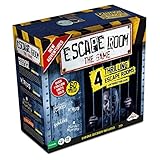
Escape Room: The Game transitions from route acquisition mechanics to collaborative puzzle-solving frameworks, emphasizing temporal constraints and collective problem-solving over individual strategic dominance. The 60-minute timer creates urgency, forcing participants to employ effective collaboration techniques and utilize diverse perspectives. Team dynamics flourish when players communicate insights rapidly and delegate tasks based on individual strengths. The game’s modular puzzle design accommodates variable difficulty levels and thematic configurations, enabling customization for distinct organizational needs. Components include encrypted locks, decoder cards, and scenario-specific props that demand systematic exploration. Players navigate unexpected twists requiring adaptive thinking and creative problem-solving under pressure. Success demands synchronized effort—no single participant can dominate the experience. This mechanical framework systematically develops critical thinking capabilities while naturally reinforcing interpersonal trust and coordinated decision-making crucial for high-performing teams.
Dead of Winter: Zombie Survival Strategy

While escape room puzzles demand rapid external problem-solving, Dead of Winter shifts the collaborative framework inward, introducing survival mechanics where internal conflict mechanisms rival environmental threats. The game accommodates 2-5 players across 2-3 hour sessions, demanding resource management discipline as teams allocate limited supplies against zombie incursions and hidden agendas. Players navigate dual pressures: cooperative objectives and potential betrayal from secret traitors. The conflict resolution mechanic forces transparent communication and strategic negotiation, as participants must balance trust with suspicion. Component-wise, the game employs crossroads cards, survivor tokens, and resource caches to simulate scarcity-driven decision-making. This mechanical framework transforms team building beyond puzzle completion into genuine interpersonal dynamics, where groups develop authentic communication strategies necessary for managing both external threats and internal uncertainty.
Forbidden Island: Teamwork Against Flooding
Forbidden Island demands synchronized teamwork as players collectively recover four treasures before an island sinks beneath rising floodwaters. The modular board shifts dynamically, creating evolving strategic challenges requiring constant team coordination and adaptive planning.
| Component | Function | Impact |
|---|---|---|
| Flood Deck | Controls island submersion | Escalates pressure progressively |
| Role Cards | Define player abilities | Facilitates specialized contributions |
| Treasure Tokens | Victory objectives | Requires coordinated retrieval |
Players assume distinct roles, each possessing unique mechanical advantages. Effective strategic planning hinges on leveraging these asymmetric abilities while managing shared resources and flooding escalation. Communication becomes vital—players must coordinate movements, anticipate threats, and allocate responsibilities without surrendering individual agency. The game mechanics enforce interdependence; no single player succeeds alone. Victory demands transparent information sharing and collective problem-solving, transforming competitive instincts into collaborative action.
Hanabi: Silent Communication Deduction
As players hold cards facing outward—visible to teammates but concealed from themselves—Hanabi inverts traditional information asymmetry, demanding deductive reasoning grounded in limited clues. The silent strategy unfolds through a constrained clue system: players may only indicate card color or number, never card purpose or ideal play timing. This mechanic forces collaborative clues to operate economically, with each statement carrying maximum informational weight. Teams navigate 2-5 player configurations across approximately 25 minutes, managing a finite clue token pool while avoiding mistakes that deplete their score. Success requires active listening and trust-building, as players construct mental models from cryptic teammate hints. The inverted card visibility creates interdependence—players cannot act on self-knowledge but rather on collective deduction, transforming communication into the game’s primary strategic resource.
